
Careers in technology often begin in unexpected places. For Hanna Kiper, a background in finance became the starting point for a journey into business analysis, where analytical thinking and an understanding of business processes play a crucial role.
Today, Hanna works as a Business Analyst in the TUI-dedicated team at Pwrteams Ukraine, helping translate complex business needs into clear, actionable requirements. Her experience across finance and IT allows her to approach problems from multiple perspectives while keeping both technical and business goals in focus.
In celebration of International Women's Day, we spoke with Hanna about her career path into tech, the skills every Business Analyst should develop, the importance of work-life balance and the lessons she has learned while working in global teams.
Read on to discover her insights and advice for thriving in the tech industry.
Hi Hanna, could you briefly introduce yourself?
Hi, I’m Hanna, a Business Analyst on the TUI project. I live in Kyiv with my partner, daughter and hamster. In my free time, I enjoy singing, learning Japanese and cooking traditional Japanese desserts.
What was your previous educational & professional background?
I started my career as a financial specialist and participated in various SAP implementation projects, providing requirements from the business side. At some point, I transitioned to IT and joined a financial project as a Business Analyst.
My financial and business background helped me a lot at the beginning of my IT career.
Tell us more about the TUI team at Pwrteams. What is it like working there?
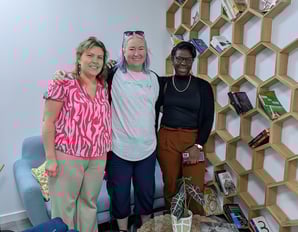 I love working with TUI. I really appreciate the freedom I have to experiment and suggest new ideas.
I support two teams, and both of them are collaborative, kind and highly professional.
We also have a lot of fun together. Even though we are all based in different countries, the atmosphere within the teams is very friendly.
What does your typical workday as a Business Analyst look like?
Supporting two teams can be quite challenging on a daily basis. One of the most difficult things is context switching, as my role requires focusing on very small details. That’s why I try to allocate larger time blocks for each team so I don’t have to switch focus as often.
Usually, the first half of my day is dedicated to one team and the second half to the other. Of course, this doesn’t always work as planned because urgent issues can arise.
Still, my main goal is to create enough focus time to prepare in advance for refinement sessions and requirements-gathering sessions.
What are the top three skills every Business Analyst should master, and how have they helped you in your career?
-
Understanding what people really need. Sometimes it’s simply experience that tells you a particular nuance is important. No one explicitly points it out, you just feel it. Being on the other side of requirements gathering helped me develop this skill.
-
Attention to detail. One small requirement can sometimes change the entire architectural approach. Lessons learnt are very valuable here. Once you’ve analysed and understood what went wrong, you’ll never underestimate the importance of that requirement again.
-
The ability to quickly understand core ideas. You don’t need to understand every single part of a solution in one day. But it is critical to first understand the main idea and then dive deeper. This helps a lot during the discovery process. Always remember the main goal.
How do you manage and prioritise tasks in a high-demand work environment?
We have quarterly planning, and each team sets prioritised quarterly goals. I keep those goals in mind when organising my work. I also challenge each task by asking: Is it a must-have or a nice-to-have?
And of course, every project has its own deadlines that we need to consider.
What do you consider your biggest achievement?
Finding a work-life balance. It has changed my life significantly.
The war in Ukraine has made the importance of work-life balance even clearer. Work is important, but it cannot be the first priority all the time.
Our energy is not unlimited, so it’s important to recharge. Quality time with family and friends, hobbies and small joys make life better.
Have you faced any gender-related biases or challenges? And if yes, how did you overcome them, and what helped you stay resilient?
I’ve been lucky to have women as my leads for most of my career. I’ve also met many women whom I admire and consider role models. This is another reason why I enjoy working with TUI. There are many empowered women there whom I deeply respect and find very inspiring.
How do you see the role of a Business Analyst in the next 5 years?
To be honest, the role hasn’t changed dramatically over the past five years, so I don’t expect major changes in the next five either.
We are just getting better tools that help us to work or tools that generate other tasks. The key skill will remain the ability to adapt to new challenges and tools.
What resources, communities or habits do you recommend for women who want to grow in the software development space?
As a Business Analyst, it is important to understand how things work in practice. Talk to developers, testers and users. Observe their work and ask questions: why does it work this way and how could it be improved?
Keep learning and exploring your product and the business behind it. And don’t forget to look at what your competitors are doing.
Interested in collaborating with talented professionals like Hanna? Check out our current opportunitiesand move forward in your career with Pwrteams.
Write your own
success story
with Pwrteams!