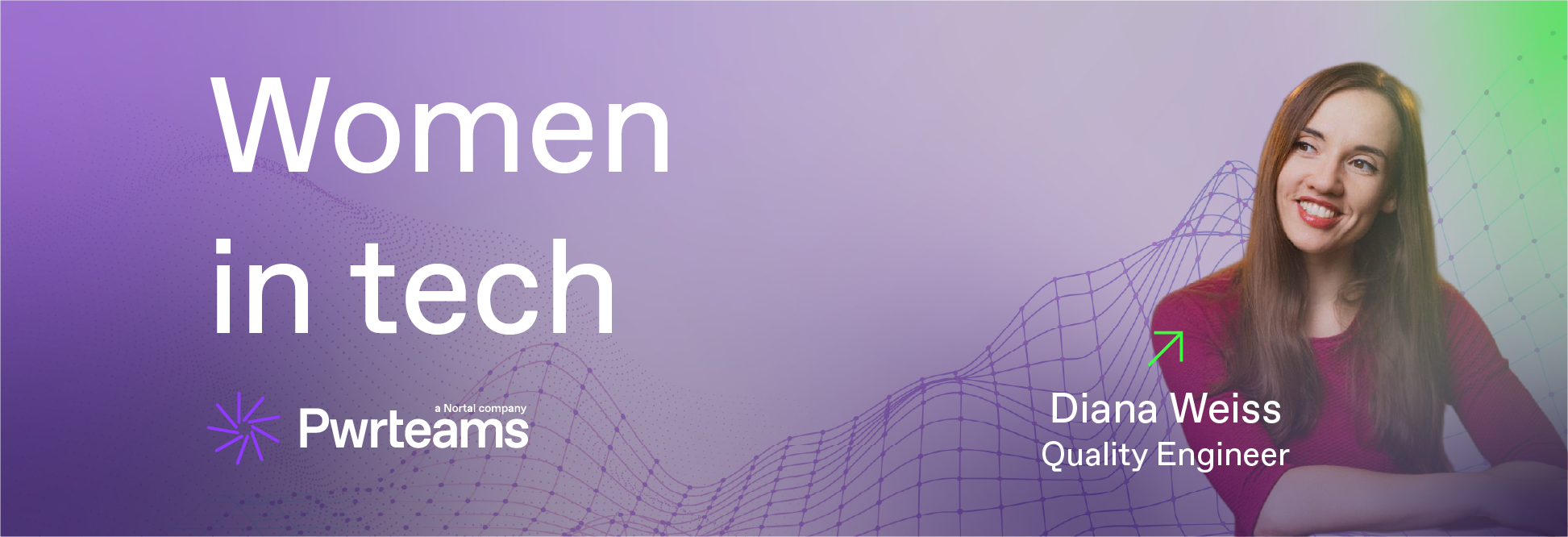
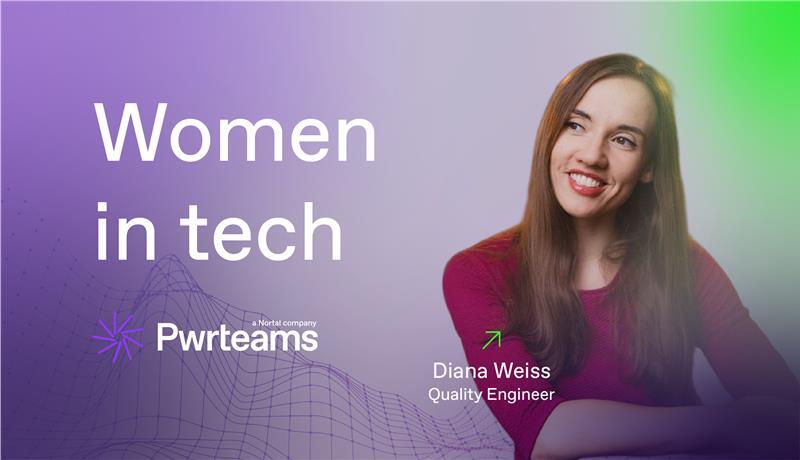
A background in law might not seem like the obvious path into software testing, but for Diana Weiss, it became a foundation for precision and structured thinking.
Today, she works as a Quality Engineer in the TUI dedicated team at Pwrteams Poland, focusing on testing TUI’s mobile application for the German market. With over seven years of experience across web, mobile and SAP environments, she has taken on both technical and leadership roles, building structured QA processes and automation frameworks.
In this edition of our Women in tech series, Diana reflects on leading QA teams, balancing localisation and accessibility testing, and why the role of Quality Engineer is becoming more strategic in the age of AI.
Hi Diana, could you briefly introduce yourself?
My name is Diana Weiss, and I’m a Quality Engineer with over seven years of experience in software testing across web, mobile and SAP environments. I’ve worked in both technical and leadership roles, including as a Test Lead and Test Manager.
Recently, I have been working primarily in test automation using tools such as Tricentis Tosca and Katalon Studio, designing and executing automated tests for complex SAP and web-based systems.
Currently, I am working on testing a mobile application for TUI, focusing on the German market. My responsibilities include localisation testing tailored to a specific region, as well as accessibility testing to ensure compliance and usability for all users.
What was your previous educational & professional background?
Interestingly, my background is in law, which significantly influenced the start of my tech career. Thanks to my legal education, my first testing role was in a project for the German Ministry of Justice, where I worked on testing software used for managing land registers. Many of my early projects were for the German public sector, where precision, regulatory compliance and structured processes were essential.
My strong connection to German projects is also personal. I come from a bilingual family - my father was German and my mother is Polish - so I grew up in a dual-cultural and dual-language environment. This naturally positioned me well for working on German-speaking projects and collaborating in international teams.
Over the past few years, I’ve expanded my experience into other industries, including automotive, consumer goods and retail - for example projects in the automotive manufacturing sector, as well as for international brands like Heineken and the DM Drogerie Markt retail network.
Tell us more about the TUI team at Pwrteams. What is it like working there?
The TUI team at Pwrteams is highly collaborative and international. What I value most is the strong engineering culture combined with openness and respect. Quality is treated as a shared responsibility, not just “the QA team’s job”.
Working there means close cooperation with developers, product owners and stakeholders across different markets. The environment is dynamic but structured, and there is space for professional growth, knowledge sharing and continuous improvement.
What does your typical workday as a Quality Engineer look like?
My day usually starts with reviewing backend automated test reports for the German mobile application. I analyse the results, identify potential issues and verify whether any failures require deeper investigation or immediate escalation.
After that, I validate the mobile frontend on production, ensuring that the application is stable and that all key user flows are functioning correctly. Since I work on the German market version of the app, I test the application end-to-end (E2E), making sure everything works consistently from backend to frontend.
I participate in daily stand-ups and collaborate closely with multiple feature teams. During release phases, I focus on UAT testing for the German mobile application, including accessibility testing and localisation validation. A significant part of my work also involves retesting bugs, clarifying defect reports with developers and ensuring that fixes meet both functional and quality standards.
My role requires constant coordination across teams and continuous monitoring of application stability. For me, quality engineering is not just about executing test cases - it’s about ensuring reliability, usability and a smooth experience for users in a specific regional market.
What are the most important skills or qualities someone needs to succeed as a Quality Engineer?
Analytical thinking is essential. You need to understand systems deeply and anticipate edge cases. Communication skills are equally important because quality is a collaborative effort.
Technical curiosity also matters - especially today, when automation, APIs, CI/CD and AI tools are becoming standard.
Finally, resilience and attention to detail are key. Sometimes you have to defend quality standards under time pressure.
Looking back, what has been your biggest achievement so far in your tech career?
One of my biggest achievements was building and leading a stable QA team with very low turnover. As a Test Lead, I focused not only on delivery but also on people - understanding individual strengths and aligning tasks with each team member’s skills and development goals. It was very rewarding to see the team grow, stay engaged and consistently deliver high-quality results.
Another important milestone was establishing a structured test automation setup in SAP projects using Tricentis Tosca. We built a dedicated SAP automation team, introduced clear processes, and created a sustainable automation framework that supported regression testing and increased release confidence. Turning automation from an idea into an operational structure was a major step forward for the organisation.
Have you faced any gender-related biases or challenges? And if yes, how did you overcome them, and what helped you stay resilient?
When I started my career in IT in 2013, there were noticeably fewer women in tech than there are today. However, most of my early projects were in international environments, largely connected to the German market. In that context, I personally did not experience discrimination or unequal treatment. The responsibilities I received were on par with those of my male colleagues, and I felt evaluated primarily based on competence and results.
At the same time, I did observe that different markets evolved at different speeds when it comes to gender balance in tech. In some more locally structured environments earlier in my career, I occasionally noticed subtle forms of bias or underestimation toward women. I believe this was less about individuals and more about broader cultural and structural development stages.
Fortunately, the situation is continuously improving. Today, diversity in tech is discussed much more openly, and awareness has grown significantly across Europe. My resilience came from focusing on competence, delivering results and choosing environments where professionalism and expertise were valued above stereotypes.
Overall, I’m encouraged by how much progress has been made, and I believe continued dialogue and visibility of women in tech will keep moving things in the right direction.
How do you see the role of a Quality Engineer evolving over the next 5 years?
In the coming years, AI will increasingly support areas such as test case generation, test data creation, defect analysis and even self-healing automation scripts. Repetitive tasks will become more automated, which means Quality Engineers will spend less time on execution and more time on strategy, risk assessment and system-level thinking.
The role is shifting from “test executor” to “quality architect”. A Quality Engineer will need stronger technical skills, including understanding automation frameworks, CI/CD pipelines, system architecture, and increasingly - how AI models work and how to validate them.
Another important aspect is testing AI-driven systems themselves. As more products integrate machine learning, Quality Engineers will need to validate non-deterministic systems, bias risks, model behavior, data quality and explainability. This requires a different mindset compared to traditional deterministic software testing.
In short, AI will elevate the role rather than reduce it. Quality Engineers who adapt, continuously learn and understand both technology and business context will become even more valuable in the next five years.
Are there any communities, resources or habits that you recommend for aspiring QAs?
Continuous learning is crucial. Online platforms, technical blogs and hands-on practice projects are very valuable. Certifications like ISTQB can provide structure, but practical experience is key.
I also recommend building small automation projects independently, even simple ones, to truly understand frameworks and CI pipelines. Being part of tech communities (local meetups, online forums, LinkedIn groups) helps you stay connected and inspired.
What advice would you give to someone considering a career in quality assurance?
Be curious about how systems work internally, not just how they look from the outside. And most importantly: build confidence in your expertise. Quality is about responsibility, clarity and courage to ask difficult questions.
It’s a challenging but very rewarding career path.
Ready to move from test execution to real quality impact?
Check out our current opportunities and join Pwrteams, where quality engineering is part of how we build better technology.