


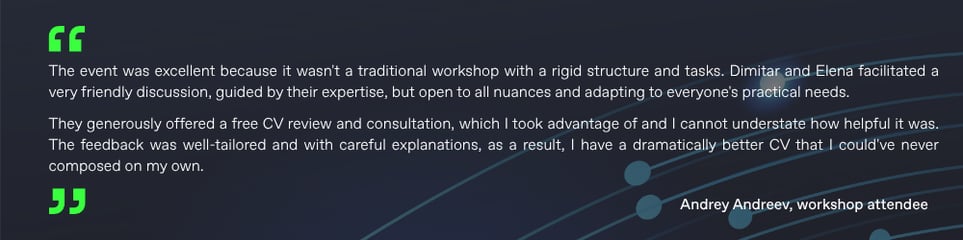
Strong candidates' CVs can also fall short if common mistakes go unnoticed. In this edition of our Career Insights series, Elena Topalova, Lead Talent Partner, focuses on the mistakes that often hold candidates back. As highlighted by feedback from one of the participants in our recent workshop about how hiring managers read CVs, even small changes can make a significant difference in how a CV is perceived. Building on the real conversations and insights from the event, Elena shares the most common pitfalls she sees and how to avoid them while keeping your CV clear, relevant and genuinely your own.
1. The myth of the perfect CV
One of the most common misconceptions about CVs is the belief that there is a single, universally correct way to write one. This is not mathematics - there is no absolute right or wrong. A strong CV is the result of a well-balanced combination of key ingredients: content, format, length and personal identity, while also considering the external context, such as the industry and the specific role being applied for.
2. When a CV lacks personality
In my experience, one of the biggest mistakes candidates make is that their CV is not personal enough and fails to stand out from the thousands of others that recruiters and hiring managers regularly review. Being different, however, should never be an end in itself. Differentiation is not easy, especially when a CV must meet both general best practice standards and the specific requirements of a particular role.
What does “being different” really mean? It means being personal enough. Add a subtle pinch of spice that reflects your individuality without, of course, overdoing it. This is especially important today, as candidates can easily fall into the trap of readymade templates, CV builder apps and even AI. While helpful, these tools often encourage people to simply compile information about their background instead of thinking critically about what to present, how to present it and most importantly, why.
My advice here is, don’t try to reinvent the wheel. Use existing tools and formats, but be critical when doing so and consciously add your own personality. This is most effectively achieved through your language – how you describe your experience, contributions, achievements and interests.
3. When design tries to do the work of content
Another common trap is the assumption that a visually appealing CV can compensate for weak content. In reality, CVs, especially in fields such as software engineering, are not meant to be highly creative. Their purpose is to be clear, informative and accurate.
Excessive use of colours, multiple fonts, tables, icons, sidebars and other design elements often distracts from the substance, making it harder to navigate the CV and quickly grasp the most important information. A visually complex CV does not guarantee better acceptance and can even work against the candidate.
What do I mean by substance? In my view, this is the ability to clearly answer one essential question: Why are you the right candidate for this position? This answer should be supported by a well-structured professional history, explained clearly, and backed by concrete facts, results and figures.
4. The use of clichés, buzzwords and generic statements
Building on the point above about substance, it’s also worth considering the overuse of clichés, buzzwords, and generic statements. They often appear in the objective or skills sections, but they also slip into work-responsibility descriptions and even hobbies and interests.
Phrases like “professional with demonstrated work history in the IT industry”, “willing to learn and develop” or “motivated, enthusiastic, hardworking individual” are so overused that they practically add no value, do not help you stand out and, most importantly, are hard to verify.
Instead of vague claims, include a short, specific example that provides evidence of your strengths. For instance, saying you built and shipped a feature within a 10-person distributed team across Europe and the USA reveals far more about your collaboration, communication and cultural sensitivity than simply claiming “excellent communication skills” or “team player”. The same principle applies to hobbies: mentioning interests like sports, music or reading only makes an impact when you add specifics (e.g., “climbed Elbrus” or “run 10 km five times a week”).

5. Forgetting the purpose of the CV and the golden rule of length
It’s easy to forget that the main purpose of a CV is not to tell your entire life story. Its primary goal is simple: to get you to the interview. A CV should highlight key points and leave “hooks” that spark curiosity and motivate the reader to start a conversation with you. It does not need to include every role you have ever had or every (irrelevant) course you completed. As a rule of thumb, a CV should not exceed two pages.
So, next time, before adding information, ask yourself:
-
Do I really need to mention my first internship from 15 years ago?
-
Should I list every university subject I’ve ever studied?
-
Do I have to add a long list of soft skills I believe I have?
-
What about information such as home address, date of birth or marital status – does any of this add value?
6. Poor use of format and space
Closely related to the previous points is the choice of format. This matters – not only because it reflects your personality, but also because it determines how effectively content is distributed on the page and how easily it can be navigated by the reader or an ATS (Applicant Tracking System).
Whether you choose a single-column or two-column layout, avoid wasting valuable space – for example, by leaving large empty margins, using an oversized font for your name or including an unnecessarily large photo. At the same time, don’t overcrowd the page – your CV needs “space to breathe.” A well-balanced layout improves readability and helps guide the reader’s eye to what matters most. It should support your content, not compete with it.
7. When responsibilities don’t tell the real story
Clearly articulating both the scope of your roles and the value you’ve delivered is central to a strong CV, but it is not always easy and often leaves room for mistakes, such as:
- Directly copying and pasting the job description
A job description lists expected responsibilities for a role, but it does not explain what you actually did, what you have achieved or how you contributed in practice. - Overly general or vague descriptions of responsibilities
Statements such as “Working with React” or “Adding new features” provide little insight into your actual impact or level of expertise. - Overly detailed task descriptions
Listing more than five to six bullet points per role is usually excessive and can overwhelm the reader instead of highlighting what truly matters. - Lack of context or, conversely, excessive domain-specific language
Either failing to explain the business or domain context or relying too heavily on internal terminology and acronyms that may not be familiar to a broader audience can reduce clarity and credibility. Just one example: what does GTM mean - Google Tag Manager or Go-To-Market?
8. Underestimating the time needed to create a CV
Many candidates believe that creating a CV is quick and easy, especially with modern CV builders that promise results in minutes. In reality, summarising the most relevant aspects of your professional background takes time, and it should!
Your CV reflects what you have achieved, how you have contributed, what you have learned and how you can demonstrate your value in your next role. Take the time (not weeks, though) to reflect, seek feedback from colleagues, discuss it with people you trust and proofread carefully before considering your CV “ready.”
9. Not adapting the CV to the job ad
Another frequent mistake is failing to adapt the CV to the specific job you are applying for. This does not mean rewriting your CV from scratch every time and it certainly does not mean exaggerating or misrepresenting your experience.
Often, small adjustments are enough: refining your summary or career objective, reprioritising certain experiences or emphasising competencies that are particularly relevant to the role.
10. Incorrect, incomplete or missing information
Finally, even strong CVs can be undermined by basic inaccuracies or omissions. Common issues include missing or incorrect employment dates, misleading or inaccurate job titles and exaggerated skills. Missing links to LinkedIn, GitHub or other relevant platforms, as well as incomplete education information, may also raise concerns.
These details may seem minor, but they directly impact credibility and trust and are often among the first things recruiters and hiring managers notice.
Conclusion
From my perspective, a strong CV works like a good movie trailer – it gives an engaging preview, leaves well-placed hooks and draws attention to the most relevant parts of your profile for the specific role you are applying for. It should be clear and concise, while balancing personality with professionalism, structure with substance and confidence with empathy for the reader. And although just a “preview,” a CV should still be the result of thoughtful reflection and be deep enough to tell a meaningful story about your value, impact and achievements. That is not easy, which is why a strong CV takes time and focused effort.




Write your own
success story
with Pwrteams!